
Estero Directory Collections by Year
Estero did not produce a verified long run of annual stand-alone directories. It remained an unincorporated community until the modern Village began in 2014. Search countywide titles, especially R.L. Polk Fort Myers and Lee County editions. The verified FamilySearch catalog reel names several years, and the 1927 title expressly says that it embraces Estero.
| Collection | Years | Where held | Access |
|---|---|---|---|
| R.L. Polk Fort Myers and Lee County directories | 1915–16, 1921, 1923–24, 1925–26, 1927, 1935 | FamilySearch reel 2308581 | Catalog; image terms vary |
| Lee general indexes and Official Records | 1887 to present | Lee Clerk and Historical Document Library | Online index and original books |
| Lee marriage-license material | From 1888 | Lee Clerk | Landmark and historical indexes |
| Marks and Brands Record 2 | 1899 | Historical Document Library | In person; photo or hand scanner |
| Federal census | Public through 1950 | NARA, FamilySearch, library tools | Free or library database |
| Newspapers and obituaries | Title dependent | Lee library and digital archive | Onsite or card terms vary |
The FamilySearch catalog record is the verified starting point for the Polk reel. A title search limited to “Estero” can miss the community section inside a Greater Fort Myers directory.
Why Estero Uses County Directories
Historical geography explains the shelf. Lee County was created in 1887, but Estero's modern Village incorporated on December 31, 2014. A short-lived Koreshan Town of Estero existed from 1904 to 1907. There is no continuous twentieth-century municipal archive that behaves like a large city's annual directory series.
Try Fort Myers, Lee County, Estero Creek, Koreshan Unity, and rural-route headings. The 1927 Polk directory gives direct proof that Estero was included in a broader publication. The 1935 title names Lee County. Old settlement along the river and U.S. 41 may also be easier to find in census, land, school, or newspaper sources than in city directories.
Postal and civic labels changed as Estero grew. Record the place wording exactly as printed. Modern boundaries should not be forced onto an early rural address.
Florida Shelves for Estero Directories
The State Library of Florida holds city directories from the early 1900s to the present, arranged by city and year. Search Fort Myers and Lee County along with Estero. Confirm access before travel because a catalog listing, a physical volume, and a digital image are different forms of availability.
The official State Library city directories page explains this statewide collection.
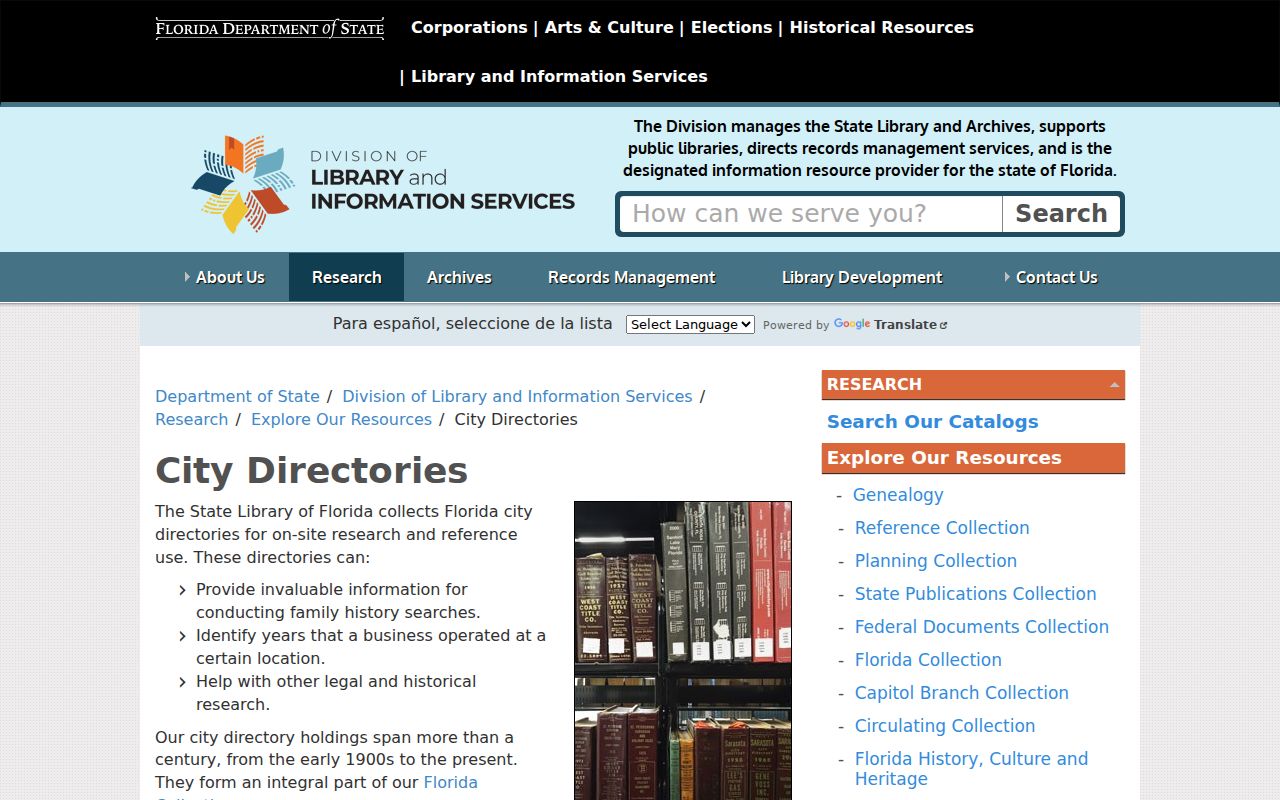
The capture points to the authoritative state shelf. It complements local holdings without promising that every Estero year exists.
South County Regional Library, at 21100 Three Oaks Parkway, is the closest county branch for Estero. Ask its reference staff to check the catalog and licensed databases. Remote terms differ by product and card status.
Read an Estero Directory Entry
No open scan verified one standard Estero entry format across every local volume. Treat the following as a field checklist for Polk-style directories, then confirm it against the abbreviation key in the exact book. Copy punctuation and marks. A small symbol can change the meaning.
| Name | Surname, given name, and initials as printed |
|---|---|
| Spouse | May appear in parentheses, depending on the edition |
| Trade | Occupation or employer may be abbreviated |
| Residence | House number, street, rural route, or place label |
| Status mark | Some volumes may note owner, renter, boarder, or widow |
| Cross-reference | Points to another name or business listing |
Do not claim every volume contains all six fields. The safest transcription includes the volume title, year, page, exact entry, and a copy of the key.
- Criss-cross directory
- A section arranged by address, often street then house number.
- Householder index
- An address-based list of the named person associated with a household entry.
- Abbreviation key
- The publisher's legend defining shortened streets, jobs, family status, and symbols.
- Rural route
- A mail-delivery designation used where numbered urban streets were absent.
Estero Research at Fort Myers
Fort Myers Regional Library's second-floor Genealogy Room is the county's main specialist collection. Its published guide lists 10,630 genealogy titles, 1,151 rolls of Fort Myers News-Press microfilm beginning in 1884, 13 rolls of the 1885 Florida state census, 100 rolls of federal census material from 1830 through 1920, more than 8,000 cards in the News-Press Necrology Index, and over 1,000 vertical-file items.
The room offers free one-on-one appointments and enhanced FamilySearch Affiliate access on library computers. HeritageQuest gives valid cardholders family and local histories plus census access; Fold3 adds military sources. Interlibrary loan allows up to three active requests. Books may arrive as copies or library-use-only items, and microfilm can be viewed at Fort Myers Regional or Cape Coral. Typical fulfillment is four to six weeks.
Start with the Fort Myers genealogy collection guide. Ask for title and year checks before requesting an item.
Lee's 150-Book Record Library
The Lee Clerk's Historical Document Library holds more than 150 original books at 2115 Second Street, second floor, Fort Myers. Its materials reach beyond normal city directories: general indexes and plats begin in 1887, marriage-license material begins in 1888, and Marks and Brands Record 2 dates to 1899. Bride and groom indexes, commissioner minutes, and tax-deed redemption books add names that may never appear in Polk.
Visitors may photograph pages or use a handheld scanner. Staff do not copy fragile or oversized books. That access rule makes a charged phone, stable camera setup, and complete citation notes important.
The original record trail survived. County history does not support a broad courthouse-fire loss. The old courthouse was demolished in 1914, and original indexes later became part of this government-office library. When an online index image is missing, the physical shelf is a real fallback.
| Date | Estero and Lee record milestone |
|---|---|
| 1887 | Lee County formed; Official Records, general indexes, and plats begin |
| 1888 | Marriage-license material begins |
| 1899 | Surviving Marks and Brands Record 2 documents ranch-era names |
| 1904–1907 | Koreshans briefly incorporate a Town of Estero |
| 1927 | Verified Polk title expressly includes Estero |
| 2014 | Modern Village incorporates, creating a coherent municipal series |
Koreshan Names Beyond City Directories
The Koreshan Unity Papers at the State Archives of Florida are Estero's deepest named-person archive. Alphabetical member files span about 1874 through 1985 in boxes 148 through 241. Related records include correspondence, admission cards, internal censuses for 1900, 1910, and 1920, membership and population lists, guest books from 1901 through 1986, deeds, mortgages, abstracts, store files, and post-office records.
Use the Koreshan property and membership guide to identify series, box, and folder. Repeated archival rearrangement means present order may not reflect the old office arrangement, so a full citation matters.
- Search the alphabetical member file by surname and variants.
- Find an admission card, member list, or internal census.
- Check property, mortgage, store, and post-office records for place evidence.
- Compare the name with federal census and the 1927 Polk directory.
- Use guest books and correspondence only with the date and context intact.
This path can reconstruct members and visitors more closely than a standard city directory, while keeping the difference between a resident, member, visitor, and land party clear.
Trace Estero Households Across Years
A city directory is strongest as one dated observation. Build a sequence rather than treating a single listing as permanent. Begin with the explicitly Estero-inclusive 1927 Polk volume, then check adjacent verified years only after confirming that the same geographic section applies.
- Copy the full entry, year, page, and abbreviation key.
- Search the same surname, spouse, trade, and address in the prior and next available volumes.
- Try rural-route, Fort Myers, Lee County, and Estero headings if the name disappears.
- Pair 1920, 1930, and 1940 directory-era evidence with the matching federal census. Public census access now ends at 1950.
- Use obituaries, probate, deeds, and newspapers to explain a move, death, or spelling change.
A missing entry can mean a move, death, publication gap, unlisted household, or changed indexing. It is not proof of any one event. A new address can be checked against a deed, but ownership and occupancy must remain separate findings.
For modern parcel and deed work after the historical trail, the Estero street directory method keeps the address angle distinct.
Fill Estero Directory Gaps
Historic newspapers and obituaries often outperform directories for early, dispersed Estero settlement. Lee County's searchable digital archive supports full-text and city-filter discovery. Search Estero Creek, Koreshan Unity, Fort Myers, rural routes, school names, and subdivision names as well as the current Village name.
The Lee County digital community archive provides the search interface. Library databases may add newspaper titles under card or onsite rules. The Genealogy Room's News-Press microfilm and Necrology Index offer a second path when text recognition misses a spelling.
School and community records can also bridge a gap. Broadway Estero School operated until 1949, while the Estero Historical Society has used records to reconstruct local house and family histories. Contact ahead because no box-level finding aid or research-fee schedule is published for the society's material.
Use Estero Directories for Genealogy
Directories work best when each fact is tied to a source date. A spouse name, trade, or route may separate two people with the same name. Neighbors may connect a family across a census and a directory year. A widow notation may suggest the next record to seek, but it should be checked against death, probate, or obituary evidence.
Owners did not always live at the recorded parcel, and seasonal patterns make that especially important in Estero. A tax mailing address can be outside Florida. A directory occupant can differ from the deed owner. Report those roles in separate lines instead of forcing them into one household claim.
Use lawful family-history and reunion purposes. Respect restricted records, survivors, and archival access terms. Private association, church, or membership rosters are not public simply because a historical collection mentions the group.