
Starting an Estero Residents Directory Search
Begin with the fact you know best. The Lee County Property Appraiser is usually first when you have a name or street address because its roll joins an owner, mailing address, site address, parcel number, sales, and permit references. A recorded instrument number can then move the search into the Lee Clerk's Landmark index. A person-centered question may instead begin with the Lee court portal, a Florida license database, Sunbiz, or the state unclaimed-property search.
No official source is a complete Estero household list. The property roll names owners, not all occupants. The voter self-lookup is designed for a voter checking his or her own record, while public voter data has separate request channels and exemptions. Printed directories cover selected years and areas. Treat each hit as a dated clue and confirm it through a second record.
- Search the Lee property roll by owner name, physical site address, or owner mailing address.
- Record the STRAP or Folio ID, legal description, and linked transaction details.
- Use the instrument number or party name in Landmark to inspect the recorded deed chain.
- Check a separate official index that fits the person, such as courts, probate, licenses, or Sunbiz.
- Ask the actual custodian for a record that is restricted online, older, unscanned, or held only at a counter.
Where Estero Resident Records Are Kept
Estero is legally a village, but the core people-and-property trail is county-centered. The Village Clerk keeps municipal agendas, contracts, planning files, permits, code matters, and records created by Village staff. The Lee Clerk records deeds and maintains trial-court files. The Property Appraiser maintains the tax roll and parcel map, and the Supervisor of Elections handles voter records. Florida's constitutional access right and chapter 119 allow any person to request nonexempt records without a general state-residency rule.
The Village Clerk's public-records page shows Estero's municipal request route.
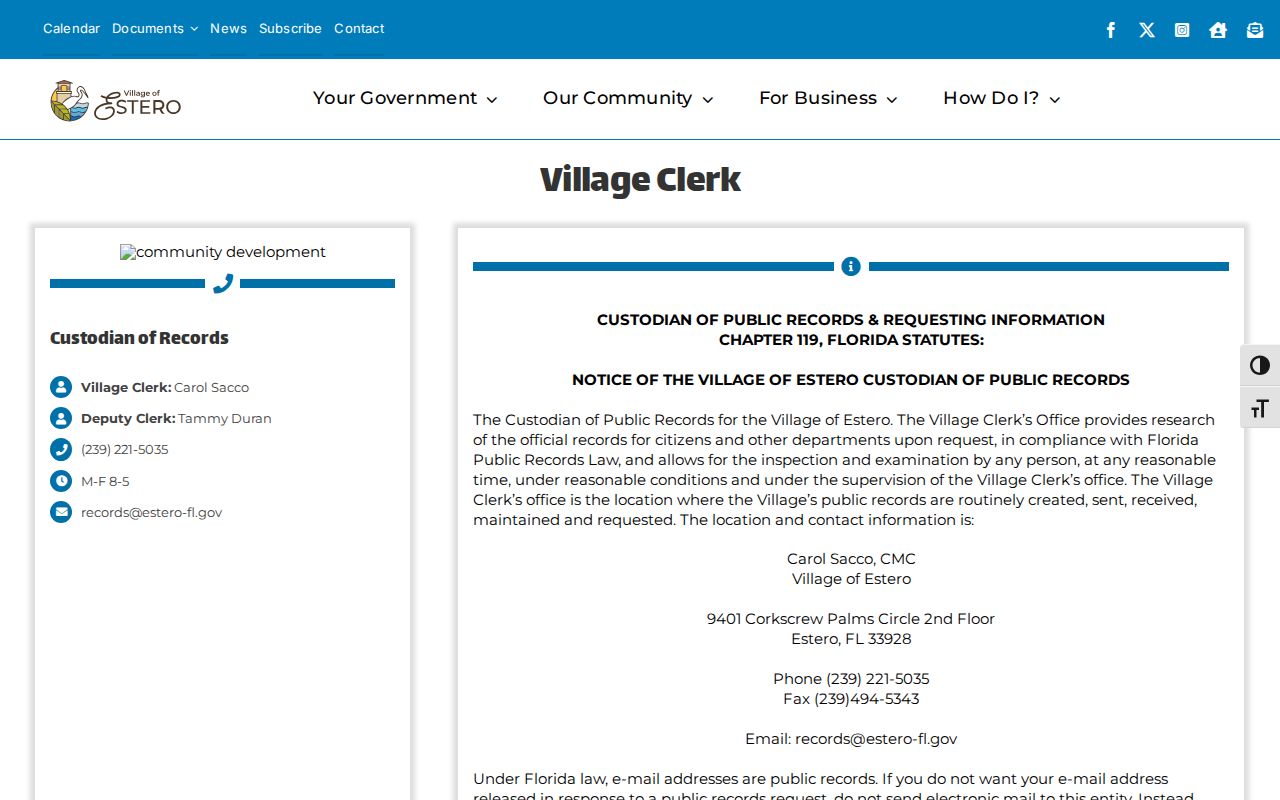
Use that office for Village-created material, while county offices remain the keepers of deeds, parcels, and trial-court records.
Lee County Clerk Official Records
2115 Second Street, 2nd Floor
Fort Myers, FL
239-533-5007
Lee County Property Appraiser
Property Data Search
Lee County, FL
Free public search
Lee County Supervisor of Elections
2480 Thompson Street, 3rd Floor
Fort Myers, FL
239-533-8683
Reading Estero Names in the Lee Property Roll
The Property Data Search has three useful tabs: Property Information, Deed/Recording Information, and Tangible Personal Property Information. The key choice is Address Source. Site Info searches the physical parcel, while Owner Info searches the mailing address supplied for tax notices. In seasonal Estero, these may differ. A distant mailing address may suggest an owner receives mail elsewhere, but it does not identify who occupies the Estero property.
| Portal field | Use in an Estero search | Important limit |
|---|---|---|
| Owner Name / Company Name | Find the tax-roll owner, entered last name first | Ownership is not occupancy |
| Address Source | Choose Site Info or Owner Info | The two addresses answer different questions |
| Street Address | Find one parcel or matching street terms | Confirm municipal boundary separately |
| Postal Code | Narrow results within a ZIP | ZIP and Village limits do not match |
| Instrument Number | Connect the parcel to recorded evidence | Some images may be restricted |
| Grantor / Grantee | Search a transfer party | Use the Clerk for title research |
The parcel card can also show STRAP and Folio identifiers, legal description, values, exemptions, transactions, permit references, and parcel-number history. A homestead flag is consistent with owner occupancy, but it is not a public list of everyone at the address.
GeoView adds the map context that a parcel card cannot. It can search by Folio, STRAP, owner last name, street number, street name, or business name. A researcher may click one parcel or draw a line, shape, or box to select several. Its layers include street labels, subdivisions, easements, the Village boundary, property values, land use, flood and evacuation zones, utilities, districts, and ZIP Codes. Selected rows can be sorted and opened for details. This makes the viewer useful for confirming whether similar street addresses refer to adjacent parcels or different jurisdictions.
Keep the stable identifiers with your notes. Street text can change, a parcel can split, and a community's marketing name may differ from its recorded subdivision name. The legal description, STRAP, Folio, and recorded instrument are better links between systems. GeoView also exposes alternate-address and parcel-number history, which can rescue a search that seems to lose a property after a change.
From an Estero Parcel to an 1887 Deed Trail
Landmark reaches back to Lee County's creation in 1887. Its search modes include name, document, case number, book and page, consideration, record date, Clerk File Number, and legal description. A current parcel's instrument number is the cleanest bridge. When searching by name, the Clerk recommends trying spelling variants and using a last name with a first initial to broaden results.
One small portal setting can hide most of the record trail: Landmark's default start date is January 1, 2010. Widen it manually when seeking an older deed. Results may show party roles, recording date, document type, instrument number, book and page, legal description, consideration, and a linked image. Provisional R or I indexing can change; V marks verified material.
Records term. An index points to a record, while a parcel is a mapped unit of land. A recorded image contains the document itself and may require separate access.
Today's Estero Residents Directory Sources
Current sources are narrow official rolls, not a single public household book. Each names a different class of person or party and carries a different date. Use the Estero residents directory as a map to the right keeper, then read the official result in context.
| Source | Who It Lists | Keeper | Access |
|---|---|---|---|
| Property tax roll | Recorded owner and mailing contact | Lee Property Appraiser | Free portal |
| Official Records index | Parties to deeds, liens, plats, and notices | Lee Clerk | Free search and public images |
| Court Records Inquiry | Parties in public county and circuit cases | Lee Clerk | Free docket search |
| Village Staff Directory | Public employees and department contacts | Village of Estero | Free web page |
| Florida license databases | Named regulated professionals | DBPR and Health MQA | Free verification |
The court, license, and business systems are best for confirming a named person's role or affiliation. The property roll and recorder are stronger for an address or ownership question. None should be stretched beyond what its keeper says it records.
Estero Court Names Need a Second Check
Estero has no municipal court. Lee County and Circuit Courts in Florida's Twentieth Judicial Circuit handle local civil, criminal, traffic, family, probate, guardianship, and ordinance matters. The public portal lets a researcher choose Criminal and Traffic or Civil, Family and Probate, then search by party, case, attorney, citation, or date where available. Partial names accept prefix wildcards.
A public result may show the case number, filing date, division, party role, attorney, docket events, status, public charges or claims, and document links. It does not prove that an allegation was true. Probate can help identify an heir, personal representative, or last-known address, but inventories and accountings may be restricted. Older items can require a courthouse terminal or records request, and sensitive filings may be sealed, confidential, redacted, or unavailable.
Search fields should be used to narrow, not to force a match. Both first and last name are normally used for a party search, and the portal permits an asterisk after partial input. Date From and Date To can reduce a crowded result list. Case categories range from civil and probate to traffic and ordinance matters, so selecting the expected division helps distinguish people who share a name. A case number or citation is more reliable than a name once known.
For federal cases involving Lee County, the correct trial court is the Middle District of Florida, Fort Myers Division. PACER requires registration and uses its current federal fee schedule. Federal and state dockets are separate, and neither replaces the other. Always read a person's role, the disposition, and the date before treating a case as relevant.
Florida Licenses and Business Names Add Context
Florida's DBPR license search and Department of Health MQA verification can confirm a license number, profession, status, issue or expiration detail, address type, and discipline link where the system provides it. Sunbiz can confirm a corporation, LLC, partnership, fictitious name, officer, or registered agent and often supplies document images. These are affiliation records, not proof of an Estero home address.
Florida Treasure Hunt adds another name-based clue through unclaimed property. A match may identify a holder or property type and provide the state claim process. It does not establish current residence. When common names collide, compare middle names, dates, entity names, parcel links, and case roles. Reject a mismatch instead of building a story from similar text.
Estero ZIP Labels Do Not Set Village Limits
The Village documented five ZIP Codes inside its boundary: 33928, 33929, 33967, 34134, and 34135. Some are associated with Fort Myers or Bonita postal labels. That means a postal city of Estero is not proof that land lies inside the Village, and a different postal label does not always place it outside.
Use USPS to verify the delivery ZIP for a complete address. Then use GeoView's Village of Estero boundary layer to test jurisdiction. This distinction controls where a permit, code, or municipal records request belongs. It also prevents ZIP-wide population or property totals from being presented as Village totals.
Public Estero Records Still Have Firm Limits
Florida's broad public-record tradition does not erase confidentiality rules. Birth certificates remain restricted for a long statutory period. Cause-of-death information has its own restricted period. Voter files withhold Social Security, driver-license, state-ID, signature-copy, protected-address, and preregistrant information as applicable. Court systems exclude or restrict adoption, juvenile, sealed, expunged, protected-victim, and other confidential material.
The Florida vital records overview separates certificate access from ordinary public indexes.
Eligibility, identification, and copy rules depend on the certificate type and age, so verify the current application before ordering.
Lawful personal use. Use public records for genealogy, civic research, property history, or reconnecting, never to stalk, harass, intimidate, or harm a person.
Commercial directory products may merge old or unrelated data without showing its source date. Official systems are narrower, but they identify the custodian, field meaning, and correction path. That provenance makes a modest official result more useful than an unexplained profile.
The Estero Village Record Series Starts Recently
The modern Village incorporated on December 31, 2014. Its coherent municipal files therefore begin around 2015, including agendas, ordinances, contracts, planning cases, public works, permits, and code records. Older Estero evidence belongs mainly in Lee County, state, federal, postal, church, school, newspaper, or archival collections.
The official text of Florida Statutes chapter 119 supplies the statewide access framework.
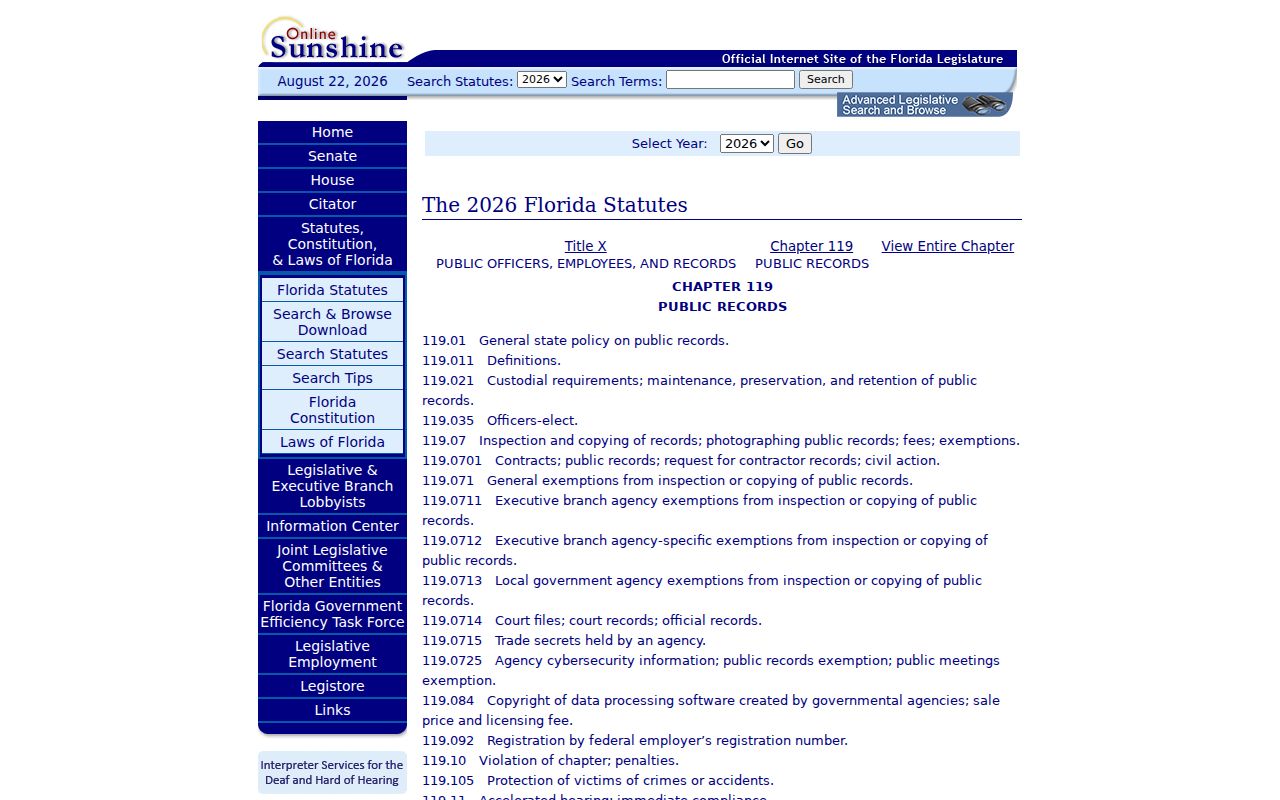
The statute works alongside article I, section 24 of the Florida Constitution and record-specific exemptions.
This creates a striking contrast. Lee Official Records begin in 1887, 127 years before the modern municipal government. An even earlier local political episode does not close that gap: Koreshans formed a roughly 110-square-mile Town of Estero in 1904, and it was abolished in 1907. Researchers should match every record to the government and geography that existed on its date.
When Estero's Online Index Is Not Enough
A public index can omit an image, start later than the underlying collection, or hide confidential material. For Village-created files, requests can go online, by email, telephone, writing, or in person to the Village Clerk. Florida generally does not require a requester to use a special form, identify a purpose, or give a name for an ordinary nonexempt record, though a precise description speeds the search.
Lee Clerk fallbacks include the Official Records counter, mailed copy requests, public court terminals, and Records Request Tracking. The Historical Document Library at 2115 Second Street holds more than 150 original books. Visitors may photograph pages or use a handheld scanner, even though staff will not copy fragile or oversize volumes. Ask for an itemized estimate before extensive work because actual duplication and special-service charges may apply.
The Village Clerk's office is at 9401 Corkscrew Palms Circle, second floor, and accepts requests during weekday office hours. A request should identify a record type, date span, address, parcel, project, or known party instead of asking staff to answer a broad question. The office may charge statutory copy fees or a special-service charge for extensive work. Since April 2025, Estero has routed open-permit and lien information through a designated property-lien process with a $50 fee rather than processing estoppel requests.
For older recorded instruments, use the Lee Clerk counter at 2115 Second Street or send a precise mailed request with the instrument or book and page, indexed name, payment, and a self-addressed stamped envelope. The Cape Coral branch is another Official Records counter, although it does not provide marriage or passport services. A clear fallback chain saves time: portal first, public counter or terminal second, then a focused request for the item that remains missing.
Historic Shelves Behind the Estero Residents Directory
Estero was small and unincorporated for most of its history, so a long run titled only for Estero is unlikely. Search Fort Myers and Lee County Polk or telephone directories for Estero headings, rural routes, and South Lee listings. A verified FamilySearch reel includes Fort Myers and Lee County volumes for 1915-16, 1921, 1923-24, 1925-26, 1927, and 1935. The 1927 title expressly embraces Estero.
A directory entry can place a named person at an address in a given publication year and may include spouse, occupation, employer, owner or renter marks, or a widow notation, depending on the volume. Reverse or criss-cross sections turn the method around by starting with street and number. Pair directory evidence with census, deeds, probate, obituaries, newspapers, and plats rather than assuming every field appears in every edition.
South County Regional Library is the nearest branch for checking Lee County genealogy services and licensed databases. The State Library of Florida arranges city-directory holdings by city and year. The Clerk's Historical Document Library adds general indexes from 1887, marriage material from 1888, plats, and the distinctive 1899 Marks and Brands volume. Together these collections give the Estero residents directory a historical layer that no current roll can supply.